
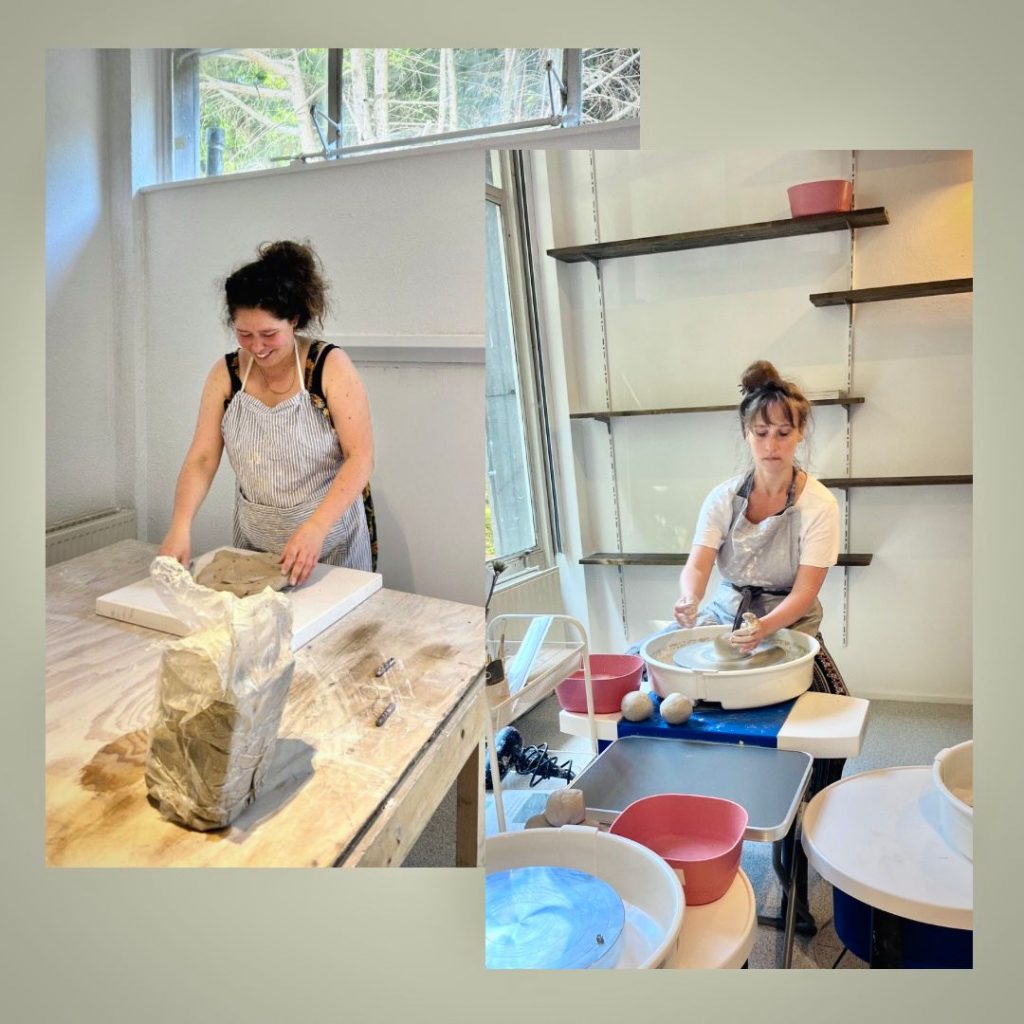
Welcome to Máris Clay Art! We are Mara and Iris, both formerly working in the performing arts, and now we are excited to make the transition to the visual arts, namely ceramics!
Of course, something like this doesn’t happen overnight! Iris started pottery in Spain over ten years ago. Mara began her apprenticeship eight years ago with her uncle, the ceramist Norman Trapman.
Mara and Iris met at a ceramics market, where they recognised each other’s talent and ambition and decided to work together.
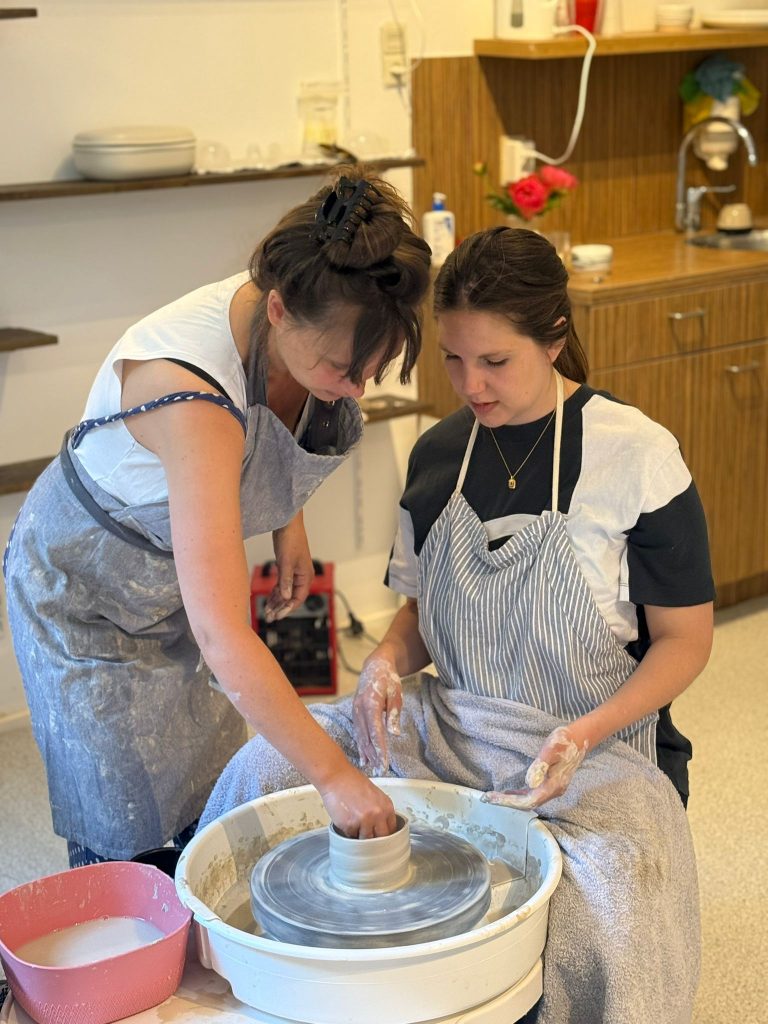
We recently wrote a press release about ourselves and our mission:
From performance art to clay art: two Amsterdam entrepreneurs turn pottery into ‘the new yoga’
On Surinameplein in Amsterdam, tucked away from the hustle and bustle of the city, you will find an oasis of calm. In a bright studio on Surinameplein, there are no DJs spinning records and no rehearsals, but the sound of the pottery wheel humming. This is where Iris and Mara (both 35) started their pottery studio – a place where meaning, creativity and sustainability come together.
The two entrepreneurs made a striking career switch themselves. Iris worked in the theatre world as a dancer for years, while Mara was a production manager and business manager in the theatre. “We always say: we switched from performance art to clay art,” they laugh. But behind the joke lies a serious quest.
A generation in search of peace and meaning
As typical millennials, Iris and Mara recognise themselves in themes that preoccupy their generation: the pressure to perform, the fear of burnout and growing concerns about the climate. ‘We noticed how normal it has become to always be “on”,’ says Iris. ‘In the cultural sector, passion is wonderful, but it can also be all-consuming.’In their studio, they want to offer a counter-movement. They call pottery “the new yoga”: an accessible way to slow down. Working with clay requires attention and presence. Your hands shape the material, your breathing slows down almost automatically, your phone stays in your bag.
‘It’s a moment of me-time,’ says Mara. ‘You develop your creativity, but without any pressure to perform. It’s not about perfection, it’s about the process.’
Response to burnout culture
Where yoga and meditation are now commonplace, Iris and Mara see pottery as a new form of mental self-care. The repetitive turning, the feel of the clay and the direct contact with the material have a calming effect.‘You can’t multitask behind a potter’s wheel,’ explains Iris. ‘If you lose focus, your pot will collapse. That sounds dramatic, but it’s actually liberating. You have to be in the moment.’
More and more young professionals are finding their way to the studio: people from the creative sector, the business world and healthcare. They come for relaxation, but stay for the feeling of connection – with themselves, with others and with the creative process.
Clay as a sustainable statement
In addition to mental peace, sustainability plays a central role. Clay is a natural material that is completely recyclable. In the studio, leftover clay is collected, reused and kneaded again. ‘We work as circularly as possible,’ says Mara proudly.At a time when climate change is in the news every day, Iris and Mara want to show that working sustainably does not have to be complicated. ‘Clay forces you to look at production differently,’ says Iris. ‘You make something with care. No mass production, but meaningful objects that last a long time.’
Entrepreneurship with a mission
Their background in the cultural sector now helps them as entrepreneurs. They combine creativity with business and are building a community around the studio. Workshops, open studio moments and collaborations with other creators are on the agenda.What began as a personal quest for balance has grown into a place where social themes become tangible: mental health, meaning, sustainability and the need to slow down in a fast-paced city.
‘We believe that working with your hands makes you human again,’ says Mara. ‘Perhaps that is the greatest luxury of our time.’
With their studio, Iris and Mara show that entrepreneurship can be more than just making a profit: it can also be an answer to the questions of a generation.